
May 2026 | Volume 27 No. 2
Check It Out
Listen to this article:
Ageing buildings are a growing problem in Hong Kong and many other major cities, and that can be a hazard. In 2021, for instance, a condominium in Florida collapsed, killing 98 people, following deterioration in its concrete and structure. Hong Kong has seen its own tragedies, such as a 2010 building collapse in To Kwa Wan that killed four people and, while caused by other factors, revealed long-standing problems with maintaining Hong Kong’s older buildings.
The risks are only going to increase because the number of older buildings is rising. At the end of 2020, the government estimated 8,700 privately-owned buildings were aged 50 or above; by 2030, that number is expected to increase to nearly 14,000 buildings. Staying on top of maintenance and repair issues is a struggle because a single building inspection can take several days to complete.
But now, help is at hand with an innovation from a team in the Faculty of Architecture’s iLab. Led by Professor Junjie Chen and Professor Wilson Lu, Chair Professor of Digital Construction, the team developed a technology that dramatically speeds up the process and lowers the cost.
eCheckGo is an AI system that can assess building cracks and other defects based on photos taken by phone or even Google Street View. The system has been tested in the real world, verified against manual inspections, and won a Gold Medal with Congratulations of the Jury at the 51st International Exhibition of Inventions of Geneva in March 2026.
“Building inspection is very important to identify defects as soon as possible and take preventive measures,” Professor Chen said. “But in reality, it is often not done sufficiently because it is labour-intensive and time-consuming. So tragedies happen again and again.”
Ease of use
eCheckGo is based on a ‘large defect model’ – a large multi-modal model that has been trained on internet-scale datasets for building inspection. The model has been fed domain-specific inspection images with textual prompts to teach it how to discern cracks and spalling (when concrete flakes or breaks away).
Users take photos inside and outside a building and upload them via a mobile app to a webpage, where the images are assessed. Defects are detected in each image and incorporated into automatically generated 3D point clouds, and the final output is an interactive 3D model that users can zoom in and out of. The whole process takes only a few seconds to process dozens of images.
“The real beauty of this is that you can easily tell the scale of the problem for a whole building and where the defects are and their geometry and dimensions. Having all that information consolidated in one place will be very helpful for decision-making about maintenance or renovation,” Professor Chen said.
The system also offers advantages over other technological solutions, such as a LiDAR (light detection and ranging) 3D scanner which is expensive to buy and operate, and computer vision approaches based on small models, which need to be trained on a case-by-case basis and are not easily transferred between buildings.
Confirmed in the field
Professor Chen and his team pilot-tested the model on two older buildings – the Pauline Chan Building at HKU and the Lux Theatre Building in Kowloon – that confirmed the performance metrics. They also did a large-scale test to see how capable the system was at grading defects on a scale of 0–10 (healthy to dangerous). Using Google Street View images of 9,172 buildings in Kowloon, the system took just four hours to produce a colour-coded map. The results were confirmed against door-to-door inspections of about 200 buildings in the area by building surveying experts.
Professor Chen also consulted industry professionals to compare the training and assessment time and costs with other systems. eCheckGo was found to be at least eight times cheaper and 100 times faster than other automated systems. The margin becomes even greater when compared with mainstream manual inspection, which can cost up to HK$150,000 including training and takes five days to produce an assessment.
The success of eCheckGo has attracted interest from various government bodies as well as industry and professional groups, and discussions are underway on adopting it in the community.
In the meantime, Professor Chen said they plan to expand detection to such defects as water leakage and dampness. They also want to enable the system to produce text reports to align with the formats preferred by building inspectors. He hopes one day to have ‘citizens as sensors’ using their mobile phones to understand the condition of their buildings.
“Urban decay is a big problem not only in Hong Kong, but in many other high-rise, high-density cities, for example, Tokyo and Singapore. We hope our system can help provide a solution to this problem,” he said.
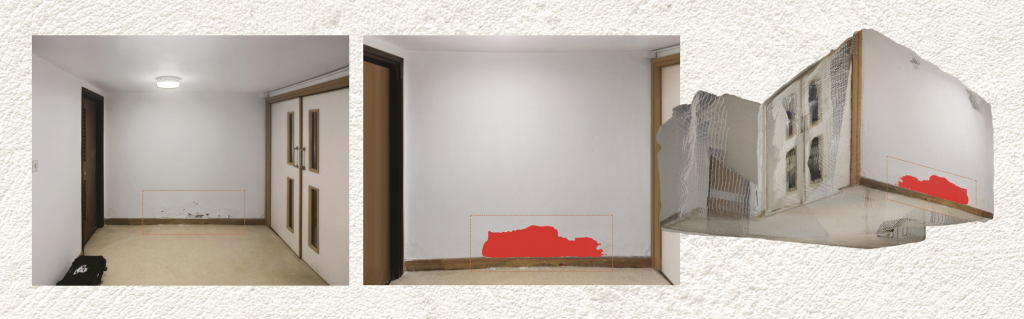
A pilot test at HKU’s Pauline Chan Building demonstrated how eCheckGo analyses mobile phone images to detect defects and generates a 3D reconstruction model to support maintenance or renovation assessments.
The real beauty of this is that you can easily tell the scale of the problem for a whole building and where the defects are and their geometry and dimensions.

Professor Junjie Chen
