
May 2026 | Volume 27 No. 2
Hitting the Right Note
Listen to this article:
The Faculty of Arts has launched Music Entrepreneurship and Popular Practice (MEPoP), a pioneering initiative which aims to bridge the gap between the creative and the business sides of the music industry in Asia by bringing together artists and music business entrepreneurs.
Like many new ideas, the seed of this initiative grew out of conversations, namely a casual exchange between Mr Jonathan Serbin and Professor Stacy Huang, both from HKU’s Department of Music, with Dean of Arts Professor David Pomfret. They were discussing the necessity of cross-sector collaborations in music and in the arts at large, and the unique position of HKU to make such connections happen. This dialogue eventually led to MEPoP.
“The music industry ecosystem is complex and ever-evolving, and creators today often need to be their own strategists to build a sustainable career,” said Mr Serbin.
“We thus believe it is crucial for the next generation of musicians to grow knowledge and sensitivity about the nuanced interplay between culture, technology and commerce,” added Professor Huang. “This is why MEPoP sets out to connect industry pioneers with emerging talent in one collaborative space.”
“We work with musicians, producers and other creatives across all genres – from hip-hop to pop to dance to classical – and layer that with business expertise from music executives, lawyers, media bankers and other key industry players,” said Mr Serbin.
He and Professor Huang first sensed a need for such an initiative back in 2022, when they co-created and co-taught two undergraduate courses in music business and music entrepreneurship.
“These courses take a rare approach in fusing practical industry know-how with critical cultural and historical insights,” said Professor Huang. “Each time they were offered, there would be a long list of auditing requests. The Department of Music at HKU is already strong in the scholarly study of music with its diverse offerings covering musicology, music theory, performance, and composition, and such industry-driven additions have further energised the programme.”
Stories of pop bands or artists unwittingly losing the rights to their own songs are all too familiar, and several of the initiatives’ upcoming courses and activities will address this issue, and from several angles. “A core objective is to empower musicians and artists with the essential knowledge and toolkit needed to protect their work, rights, and income,” said Mr Serbin. “An example is ‘Create, Copyright, Collect’, a short course that offers an understanding of the origin and historical development of copyright. It allows students to identify the various income streams available and introduces them to the workings of various royalty collection agencies.”
AI and music
In the next phase, MEPoP will roll out more public-facing courses, programmes and activities: with topics ranging from music entrepreneurship to songwriting in today’s market, as well as how to critically approach AI’s intersections with the creative economy.
“Whether we like it or not, recent advancements in AI technologies and their increasing impact on the creative arts and cultural industries present challenges that many of us have to confront in daily work and life. The music industry is no exception,” said Professor Huang. “This May, MEPoP will roll out a short course titled ‘Artificial (Un)Creativity: The Question of AI in Music’, where we assess both the opportunities and impediments brought about by such technologies and together envision our ways forward.”
As a public-facing initiative, MEPoP is designed to reach a wide range of audiences, including but not limited to university students. “With the diverse programmes that are being planned, we are confident that music enthusiasts from all walks of life will be able to identify activities that speak to their interests,” said Mr Serbin.
“It’s our vision to build MEPoP into a dynamic hub in Hong Kong – and eventually Asia – that simultaneously embraces artistic practice, entrepreneurial thinking, and critical inquiry about the creative cultural industries (with a focus on the music sector),” said Professor Huang.
They successfully launched the MEPoP public event series with three talks. One with influential Mandopop lyricist Vincent Fang – known for his decades-long collaboration with Jay Chou – that inaugurated the ‘Icon Insights’ series; one with Clockenflap co-founders Mike Hill and Justin Sweeting that kickstarted the ‘In Conversation’ series; and the third with Professor Gus Xia who visited from Abu Dhabi to share with audiences the state of the art in music AI research and its industry impact.
“We also officially welcomed Mr Vincent Fang as the inaugural MEPoP Industry Fellow,” said Professor Huang, “and we are excited to bring more talents and leaders onboard to together drive MEPoP.”
While the initiative currently focusses on the music industry, the information it offers in areas such as intellectual property management and creative entrepreneurship is fundamentally applicable across the artistic disciplines, so similar initiatives could be undertaken across theatre, film etc.
Professor Huang and Mr Serbin explained that they define ‘popular practice’ – that is, the ‘PoP’ of MEPoP – broadly and value multi/inter-media art forms tremendously, so MEPoP will certainly expand into more creative domains that reach beyond music.
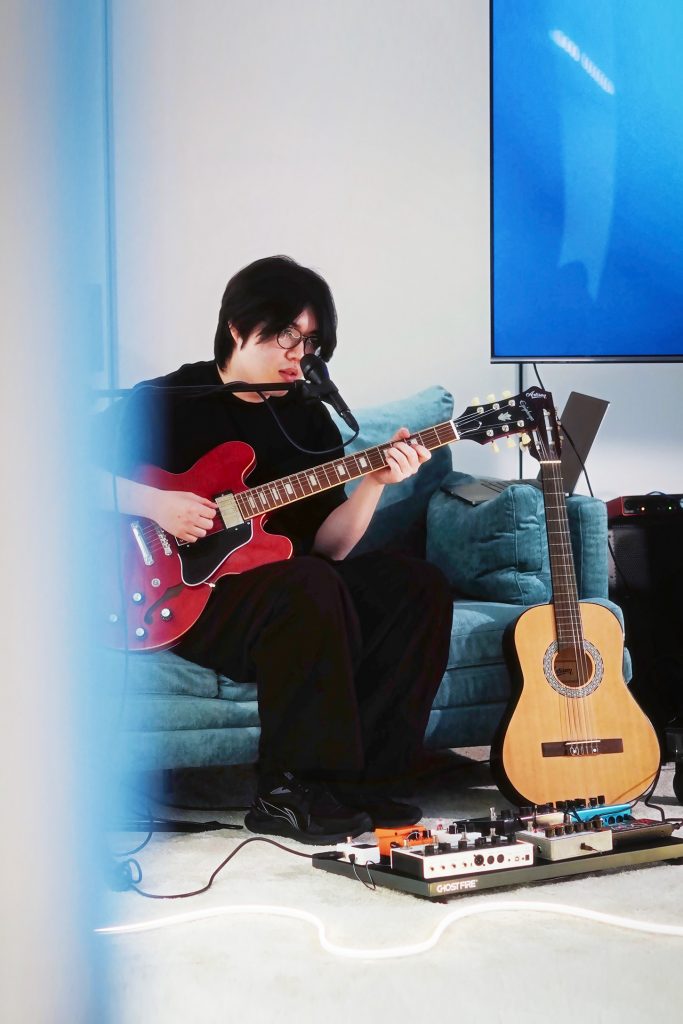
In March 2026, a new workshop series ‘In Tune’ was launched to showcase rising young artists across various genres and practices. The inaugural session, ‘In Tune: How Music Thinks’, was led by independent musician, songwriter, and jazz instrumentalist Maru Ma.
It’s our vision to build MEPoP into a dynamic hub in Hong Kong – and eventually Asia – that simultaneously embraces artistic practice, entrepreneurial thinking, and critical inquiry about the creative cultural industries.

Professor Stacy Huang
